

Buying a rental property is one of the most common ways Australians build long-term wealth. Done thoughtfully, it pays you for decades. Done in a rush, on BBQ advice, it can be a costly experience. The difference almost always comes down to decisions made before you sign a single document.
Most first-time investors fall into the same predictable mistakes. Wrong finance setup. Wrong cost expectations. Wrong team. Wrong market. This article walks through what every Australian investor, first-time or seasoned, should think about before committing to a property. Property investing is a deep subject and we will keep building on it. But this is the foundation.
1Get the right information first
Everyone knows a "little" about property. Very few know everything. When we go to BBQs or social gatherings, we all have that one mate who tells us to do it this way or that way, based on what worked for them once or something they heard from someone else. Their heart is in the right place. But what worked for them might not work for you at all. Different financial situation, different market, different timing.
Skip the BBQ advice. Three credible places to start your research:
- A property expert or licensed buyers agent. The right first call for most new investors. They know markets, they know what to look for in a property, and they know the obvious traps. They are not tax experts, but they are a strong starting point.
- A registered tax agent. For everything tax-related: deductions, depreciation, capital gains, structuring. You can verify a tax agent through the Tax Practitioners Board.
- The ATO. The official source of truth on what you can and can't claim on a rental property. We reference it throughout this article.
If you are using your super to buy property, you will also need an accountant who specialises in self-managed super funds. That is its own world and we will cover it in a separate article.
Whichever path you take, get the right information before you commit. Records start the day you buy. Decisions made in week one shape your tax outcomes for decades.
2Sort your finance strategy before you start looking
Don't lock yourself into one bank with a pre-approval. It is a strategy banks use to get you to commit to them, and it can hurt you when you actually find a property.
Here is why. Every bank values a property differently. Bank A might come back with a valuation 5% below the contract price. Bank B might come back at value. If you are already pre-approved with Bank A, you either have to make up the shortfall yourself, drop your offer, or restart the entire application process with Bank B. By that point you may have already lost the property.
The smarter move is to speak to a mortgage broker who works with multiple lenders. Get an indicative approval from several banks first, with all your supporting documentation prepared and ready to lodge. When you find the property and have a contract in hand, you submit the application to whichever bank gives you the best valuation, the best rate, and the best terms for that specific deal.
Important note on valuations
A low valuation does not necessarily mean the property is overpriced. Different valuers use different benchmarks. Some are conservative by nature. Some are working off firesale comparisons in a soft market. The point here is just that being locked into one lender too early can cost you the deal. Valuations themselves are a topic for another article.
3Know your strategy, and invest within your means
Before you start looking, decide what kind of investor you actually are. Your strategy shapes everything else: which markets you buy in, what kind of property you target, how much you borrow, and how active you need to be.
Capital growth
Buying in markets where prices rise faster than rent. Often negatively geared. Suits high-income earners with a long horizon and the cash flow to absorb shortfalls.
Cash flow / rental yield
Buying for the rent, not the resale. Often regional or outer suburbs, often positively geared. Suits investors who need the property to pay for itself from day one.
Balanced
The middle ground. Modest yield with steady, defensible growth. Often a good fit for first-time investors who want both ends covered.
Value-add (renovation)
Buying under market and lifting both rent and resale value through renovation work. Strong upside, but it is not a side project. Expect to give it 20 to 30 hours a week and to have a tradie network you trust.
Subdivision or development
Splitter blocks, dual occupancy, granny flats, full developments. These strategies have the biggest upside in property investing, but they also carry the biggest risk if you get them wrong. Do not take them on without serious capital and expert guidance.
Timing the market
Trying to buy at the bottom of a cycle. Hard to do well, easy to get wrong. Most experienced investors will tell you that time in the market beats timing the market.
The right strategy is the one you can actually execute. If you do not have 20 to 30 spare hours a week, do not commit to a renovation project. If you do not have expert guidance, do not take on a subdivision. If you do not have the cash flow buffer to absorb interest rate rises, do not gear yourself to the maximum on a negatively geared deal. Match the strategy to your time, your capital, and your expertise. The Instagram version of property investing rarely matches reality.
4Know which costs you can claim, and which you can't
The ATO splits rental property costs into three buckets. Get them mixed up at tax time and you will either underclaim, overclaim, or end up paying more capital gains tax than you should when you eventually sell.
- Interest on the investment loan
- Council rates and water rates
- Property management and agent fees
- Repairs and maintenance (after the property is rented)
- Landlord insurance premiums
- Body corporate / strata fees
- Pest control, gardening, cleaning between tenants
- Depreciation on the building and assets (for residential property bought after 9 May 2017, only new assets you install after purchase qualify, not the second-hand ones already in the property)
- Loan establishment fees
- Title search fees
- Lenders mortgage insurance (LMI)
- Mortgage broker fees on the loan setup
- Stamp duty on the loan documents (not the property)
- Stamp duty on the property purchase
- Legal and conveyancing fees
- Buyer's agent fees on the purchase
- Initial repairs (see next section)
That last bucket matters more than most people realise. The costs sitting in your cost base reduce your capital gain when you eventually sell, which reduces the capital gains tax you pay. Track them from day one. Keep every receipt and every invoice. The ATO requires you to keep these records for five years after you sell the property, not five years from the date you bought it.
5Initial repairs are not deductions
The ATO is very clear on this one. Any work you do to fix damage that already existed when you bought the property is treated as an "initial repair". That is true even if you do the work before tenants move in.
Examples of initial repairs the ATO names:
- Painting walls that were scuffed at settlement
- Replacing damaged floorboards
The same principle applies to anything else that was already broken when you bought, such as a leaking tap or a cracked tile.
None of this is deductible in the year you do it. Most of it goes into your cost base, where it reduces your capital gain when you eventually sell. Some bigger jobs may instead be classified as capital works (claimed gradually over 40 years) or as depreciating assets (depreciated over the asset's useful life). Your accountant will tell you which bucket applies.
There is a planning trick here. If the work is not urgent, schedule it after the property has been rented for a while. Once the property is genuinely tenanted, future repairs caused by ordinary wear and tear during the tenancy are deductible in the year you do them. Same job, different timing, very different tax outcome.
This catches almost every first-time investor by surprise. Do not assume that because the work happens "in connection with" the rental, it is automatically deductible.
6Growth and cash flow
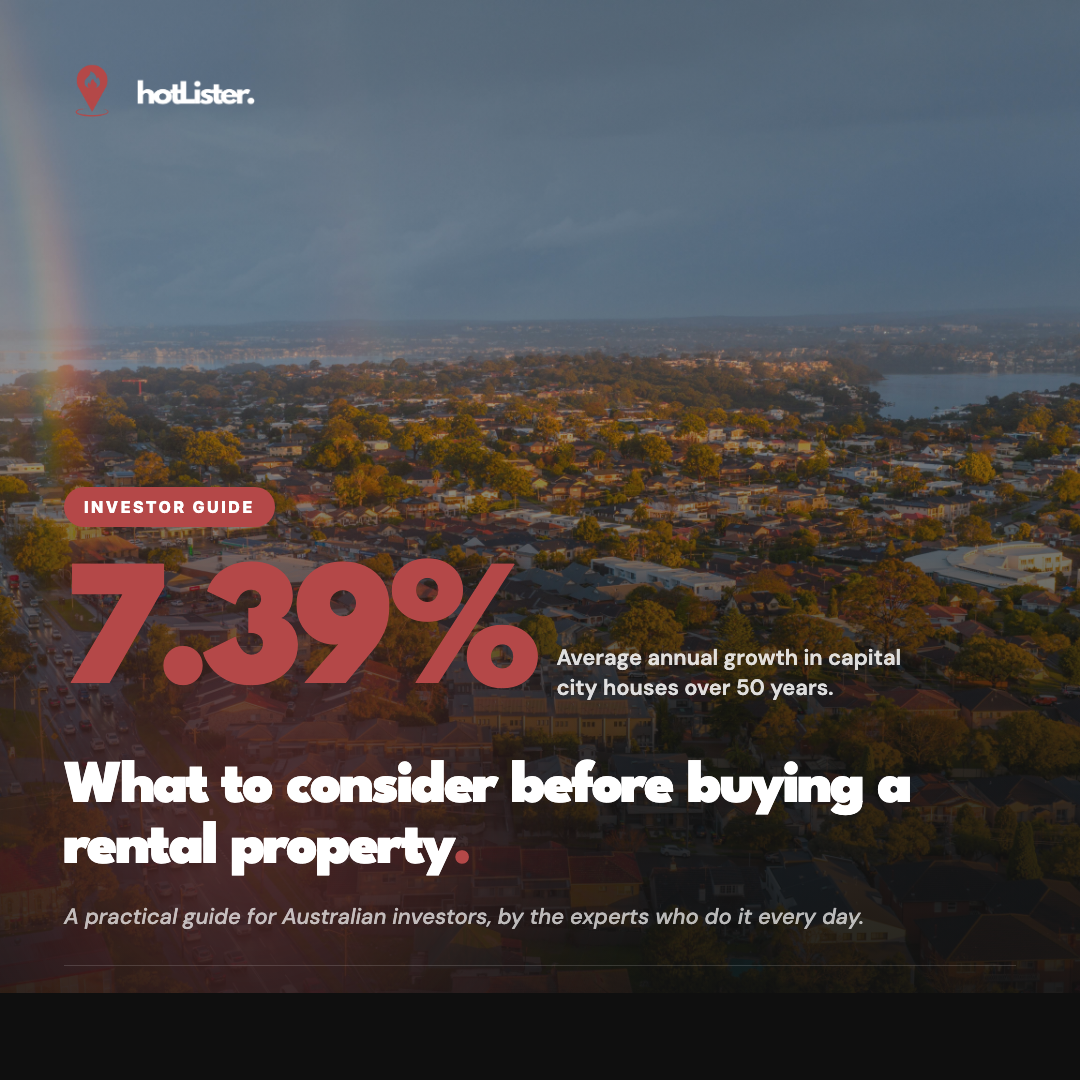
There are two ways a rental property pays you. Capital growth (the property goes up in value) and cash flow (rent comes in faster than expenses go out). Most Australian investors lean toward capital growth, and the long-term data supports that lean. Average capital city house prices in Australia have risen by around 3,435% since 1975, which compounds to roughly 7.39% per year over the past 50 years. That growth is what has quietly built most Australian property wealth over the past five decades.
The compounding maths is what does the work. A house bought for $500,000 today, growing at 7.39% a year, is worth around $1.02 million in 10 years and $2.08 million in 20. Time in the market is the input. Patience is the strategy.
The trade-off is short-term cash flow. The ATO defines a property as "negatively geared" when the rental income is less than the deductible expenses. The shortfall can offset other income, reducing your tax bill. Negative gearing benefits higher-income earners (37% and 45% tax brackets) more than middle-income earners. While the property is negatively geared, you are funding the deficit each month, banking on growth to outweigh it over the long term. With a strong growth thesis and a cash flow buffer to hold through rate rises and vacancies, this has been a proven long-term strategy in Australia. Without that buffer, it can stretch you thin.
Quick rule of thumb on the cash flow side. At current interest rates of around 6 to 6.5%, you generally need a gross rental yield above 7.5% for a property to be cash flow positive from day one. Positively geared properties fund themselves and ride out rate cycles. Negatively geared properties trade short-term cash flow for long-term growth.
Whichever lever you are pulling, run the cash flow numbers before you sign anything. Work out what rent the property realistically commands, then subtract every outgoing: loan repayments, council and water rates, insurance, property management, maintenance buffer, vacancy allowance, body corporate. Test it against future rate rises. The investors who do well decide upfront which lever they are pulling, then plan accordingly.
hotLister Property Investment Analysis (PIA). Members can run a full cash flow and capital growth assessment on any listing on hotLister, save the results, and compare properties side by side. Available inside the Members Area.
7Look beyond your backyard
Most first-time investors only look in their own suburb or city. It feels familiar, it feels safe, and they assume their local market is as good as any other. The old saying goes, you don't know what you don't know. So it pays to broaden your horizons.
Australia has more than 15,000 suburbs across eight capital cities and hundreds of regional centres, and different markets cycle at different times. Sydney can be flat while Perth booms. Brisbane can be pulling ahead while Melbourne softens. Regional Queensland can be running double-digit growth while inner Sydney barely moves. The investor who only looks in one place is paying full retail in one cycle while ignoring better cash flow and growth opportunities in another.
What to look for when researching a market:
- Population growth, especially net interstate and overseas migration into the area
- Infrastructure pipeline. New schools, hospitals, transport links, employment hubs
- Vacancy rate. Below 3% means low vacancy and strong rental demand
- Median rent vs median price. The yield equation, suburb by suburb
- Stock on market trends. Rising means more competition, falling means tightening
- Days on market. Shorter means stronger buyer demand
Buying outside your local area unlocks three things at once. Affordability (your $700,000 might buy a 3-bedroom house in Adelaide and a one-bedroom shoebox at home). Diversification (one local downturn does not sink your entire portfolio). And access to growth-and-yield combinations that simply do not exist in expensive capital cities.
It is uncomfortable to swallow the pill that your own backyard is rarely the best market. But the data tells you that almost every year, the top-performing suburb in Australia is somewhere most investors have never personally visited.
hotLister Suburb Report Cards. Key statistics for every suburb in Australia, in one place. Median price, rental yield, vacancy rate, days on market, demographic indicators. Available inside the Members Area.
8Overlooked costs
Most first-time investors budget the deposit and the loan, then get caught off guard by everything else. The costs that get missed:
A 5-10% buffer on top of the purchase price
For stamp duty (varies by state), legal and conveyancing fees, building and pest inspections, loan establishment, lenders mortgage insurance if your deposit is under 20%, depreciation schedule preparation, and initial setup costs. On a $700,000 purchase, that is roughly $50,000 to $70,000 on top before you have earned a single dollar of rent.
Three insurance policies, not one
These are three different products. Standard home insurance does not cover landlord risks. Landlord insurance does not cover the building structure. You generally need at least the building and landlord policies on every investment. Premiums for landlord insurance typically run $800 to $2,200 per year, and the premium is tax deductible in the year you pay it.
Property management
Always use a licensed property manager. Australian tenancy laws are strict, vary by state, and getting any single notice or process wrong can cost you months of rent or land you in front of a tribunal. A licensed manager costs around 7 to 9% of rent, handles tenant selection, bond lodgement, condition reports, repairs, rent collection, and legal compliance. The fee is also tax deductible. The risk of self-managing is far higher than the saving.
A vacancy buffer
Even in a tight rental market, expect 1 to 4 weeks of vacancy per year between tenants. Build that into your cash flow calculations. The investor who plans for 52 weeks of full rent gets caught short the first time a tenancy ends mid-year.
9Get a professional to check and negotiate the contract
Don't just sign what the seller's agent puts in front of you. A standard real estate contract is written to favour the seller. Your job, and the job of the professional you hire, is to push the contract back to neutral.
Negotiation is not just about price. It includes:
- Subject to finance clauses, with a realistic timeframe (typically 14 to 21 days) so your loan can be arranged properly
- Subject to building and pest inspection clauses that let you walk away or renegotiate if something serious comes up
- Settlement timeline. Too short and you are scrambling. Too long and you risk holding costs
- Inclusions and exclusions. What is staying with the property: curtains, dishwashers, garden sheds, fixtures
- Special conditions for your situation. For example, access for a depreciation schedule before settlement, or vacant possession at handover
- Deposit terms. How much, when paid, where held
Get a conveyancer or solicitor who works with investors to review the contract before you sign anything. The cost (typically $1,000 to $2,000 for conveyancing on an investment purchase) is small compared to the cost of finding out three months later that you have signed a contract with terms that hurt you.
10How to find the right property
Once you know your strategy, your finance position, your target market, and you have the right team around you, finding the right property is the easier part. But it still takes work.
Things to check on every property you shortlist:
- Genuine recent sales comparisons, not just the listing's own marketing
- Rental comparisons for the same suburb and property type
- Building condition. Always get a formal building and pest inspection
- Strata or body corporate health if it is an apartment or townhouse
- Zoning and any planning changes nearby (council and state planning portals)
- Flood, fire, and bushfire overlays
- Recent days on market and price drops in the area
hotLister Buyers Agent Picks. Handpicked investment properties uploaded weekly by experienced buyers agents, available to members. Plus Market Watch: set your target area and get notified the moment a new listing matches.
The bigger picture
The ATO's own example article tells the story of Jing, a first-time investor who based her early decisions on advice from friends rather than professionals. She got several things wrong. She assumed purchase costs were deductible (they were not). She assumed pre-tenancy painting could be claimed (it could not). She did not understand which records to keep. Each mistake by itself was small. Together, they shaped Jing's tax outcomes for years.
That is the point. The decisions made before you buy, in week one, in month one, are the decisions that shape your investment for the next 10, 20, 30 years. Get the team right early. The right broker. The right conveyancer. The right accountant. The right property manager. The right buyers agent. Everything after that is easier.
The honest summary
Buying a rental property is one of the most common ways Australians build wealth. Done thoughtfully, with the right information and the right team, it pays you for decades. Done in a rush, on BBQ advice, it can be a costly experience. The difference is the work you do before you sign.